


Toxic Accounts
From Greenwashing to Gaslighting
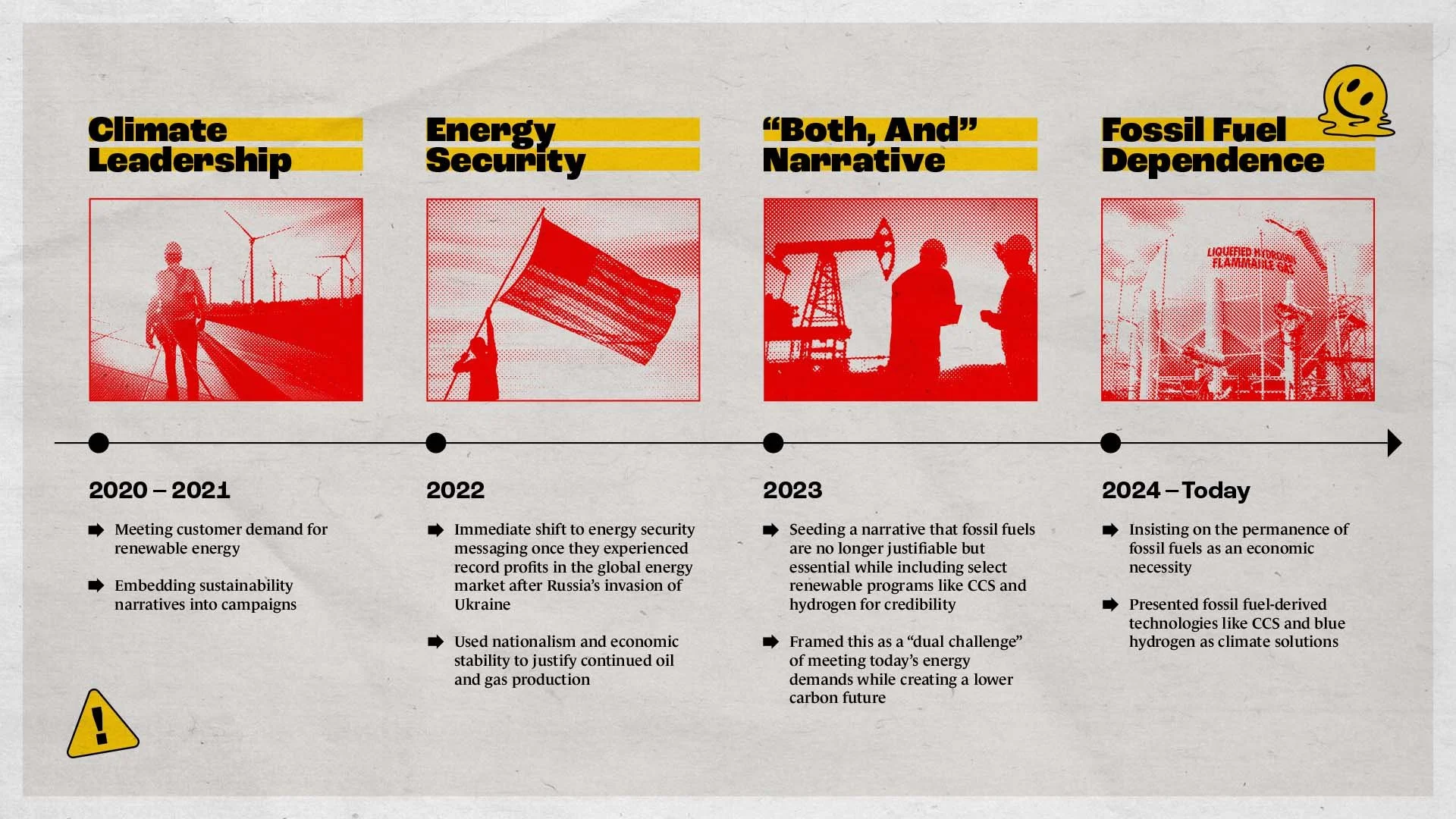
In February 2022, Russia’s invasion of Ukraine disrupted global energy markets and shifted attention towards energy security. Today, we’re seeing the fragility of the global fossil fuel markets due to the escalation involving Iran and the wider Middle East, which is spiking oil prices. In previous years, especially after the Paris Agreement, several oil majors had set net zero ambitions and committed to a sustainable transition, even though they continued to invest in fossil fuels. However, once oil and gas companies experienced record profits in 2022, they abandoned transition plans and refocused on fossil fuel production and shareholder returns.
In a first-of-its-kind research project, Clean Creatives has decoded the narrative shifts in fossil fuel campaigns between 2020 and 2024, detailing how narrative strategy in oil and gas companies' advertising and PR campaigns has shifted.
Our evidence documents how, between 2020 and 2024, oil and gas campaigns shifted from setting climate targets and saying “we’re part of the solution” to emphasizing fossil fuel dependence and convincing people “you can’t live without us.” In parallel, we saw shareholders follow suit and move from supporting climate action to prioritizing fossil fuel profitability.
Oil majors have always been preoccupied with social license, but now, the fossil fuel industry is radicalizing. Companies like BP and Shell, which have a history of greenwashing and made net zero pledges in 2020. Now they are going all in on fossil fuels. They’re advertising false solutions like CCS, natural gas and biofuels, which increase fossil fuel dependence.
Greenwashing is no longer the core strategy of the fossil fuel industry — it’s about power and political influence.
For decades, advertising and PR agencies have helped oil and gas companies manufacture climate doubt, spread disinformation and delay decarbonization. Today, their tactics are becoming increasingly manipulative and strategic, aimed at convincing people that we can't live without fossil fuels, when, in fact, 91% of renewable projects are cheaper and more reliable than fossil fuel alternatives. 2025 marked the first year renewables overtook coal in the global electricity mix.
The world has moved on from fossil fuels, but oil companies want to keep you hooked. They may be trying to differentiate themselves, but they are all following the same playbook. Over the years, their narrative strategy has moved from climate leadership (2021) to energy security (2022) to using a “both, and” narrative to promote fossil fuel expansion and emissions reduction (2023) to asserting fossil fuel dependence (2024).
Toxic Accounts is the first-ever qualitative project to decode the narrative shifts in fossil fuel campaigns between 2020 and 2024 and present the new oil and gas playbook.
Writer and Head of Research: Nayantara Dutta
Research by Source Nine Insights
Timeline animation by Fionn McSherry
Methodology
At Clean Creatives, we have been tracking the fossil fuel industry and its ad campaigns since 2020. We developed this study to investigate whether there had been a narrative shift where greenwashing was no longer the focus of fossil fuel campaigns. We found much stronger support for our hypothesis than expected, and clear and conclusive evidence to suggest that we are in a new era of oil and gas communication, which is all about fossil fuel dominance.
We analyzed 1,859 campaign materials from BP, Chevron, ExxonMobil and Shell between 2020 and 2024 to identify the emotional needs they address and narrative shifts they indicate. We chose these four oil majors as they operate globally, faced pressure to change their strategy in response to global politics, and released several creative campaigns during this time period. We excluded TotalEnergies and Petronas due to a lack of creative work available for analysis and did not include local oil majors, as they would not have been exposed to the same pressure to transition.
To build our dataset, our research partners at Source Nine Insights created a custom GPT to collect, condense, and organise publicly available campaign materials from these oil majors from 2020 to 2024. This includes YouTube videos, social media posts and digital ads on Facebook, LinkedIn, TikTok and Instagram, executive speeches, press releases, interviews, and TV commercials on iSpot.tv, Ad Forum and Ads of the World.
After receiving the raw data, Clean Creatives evaluated each primary source and developed a summary of keywords and key themes. Separately, Source Nine used their custom GPT to analyze the raw data and develop outputs including the narrative strategy tables. Clean Creatives built our own analysis and narrative tables based on primary review of sources, without referencing Source Nine’s AI analysis.
Lastly, we compared our findings with Source Nine’s AI analysis. We discovered that they had only one area of overlap in the key themes indicated in the narrative strategy tables, which we’ve included. This report reflects Clean Creatives’ primary analysis.
Although our analysis had a global scope, we found the narrative shift most prominent in campaigns from the U.S. and U.K. and have focused on those case studies in this report. During this period, creative work from Asia and the Middle East largely continued its usual focus on family values, brand loyalty, cost savings, and purpose-washing.
Fossil fuel campaigns have been influenced by geopolitics, but we found that this narrative shift followed its own timeline, independent of political influences. It does not coincide with electoral cycles or any other shifts in global politics. Instead, it reflects a clear and strategic agenda for fossil fuel domination developed by the oil and gas industry.
Key findings
Oil and gas companies are following a common playbook. Their marketing has shifted from clean energy to lying and manipulating the public into believing we need fossil fuels for a safe future, even though clean energy is cheaper, faster, and more reliable.
They are selling fossil fuels as false renewable solutions. Instead of actually investing in renewables, oil and gas companies are promoting natural gas and CCS as sustainable technologies, even though they are derived from fossil fuels, will not work at scale, and will delay decarbonization.
False solutions are making it harder for us to agree on a path forward. By promoting CCS and biofuels as legitimate technologies, oil majors are concealing the fact that renewable energy is the best available solution. As a result, greenwashing becomes both intentional, by the companies spreading these narratives, and accidental, by the people who believe them.
Marketing campaigns are delaying a clean energy transition by presenting oil and gas as the only solution for energy security and economic stability. In fact, oil and gas demand has only increased because oil majors and governments are causing a “slower adoption of renewable technologies”, which has made it “inevitable” that we will overshoot the Paris Agreement’s 1.5°C global warming target.
Nobody can make a sustainable transition due to the wider systemic pressures. These companies have to follow whoever is winning. The urgency of the transition has gone, and it’s all about shareholder value and short-term returns. There is an absence of leadership to step in and recognize this problem.
Oil majors are on a path of mutual destruction. Any illusion that agencies could nudge fossil fuel clients toward transition is gone. Oil and gas companies aren't interested in transitioning; they're prioritizing short-term returns and doubling down on fossil fuels.
Timeline
False solutions
-
Oil majors are positioning natural gas as a “bridge fuel” to cleaner sources of energy, even though natural gas is mostly made up of methane, a fossil fuel which is 81.2 times more powerful than carbon dioxide over 20 years and responsible for 30% of human-caused global warming.
-
Carbon capture is Big Oil’s favorite green solution, even though it’s expensive, unreliable, and is increasing oil production. 88% of CCS projects have failed, and most captured carbon dioxide is used for enhanced oil recovery, which produces more fossil fuels.
Renewable energy is significantly cheaper and more dependable than CCS. In 2023, the University of Oxford found that a heavy CCS pathway to reach net zero by 2050 would cost “at least $30 trillion more than a route based primarily on renewable energy, energy efficiency and electrification.”
However, oil companies in the U.S. have lobbied for CCS for decades and are set to receive an estimated $30 billion in tax subsidies from 2022 to 2032, regardless of whether they are storing gas underground or using it to increase oil production. In subpoenaed internal documents, Shell admits that it uses CCS to “retain a larger market share for our products in the energy transition, in addition to reputational value.”
-
Oil majors like BP and ExxonMobil are proposing three types of hydrogen (green, blue and gray) as energy solutions for heating and transport. But BP and ExxonMobil's proposed versions would all be extracted from existing energy sources like methane, carbon dioxide and natural gas, which would lead to prolonged fossil fuel demand and infrastructure. Hydrogen can be an effective solution if it is made using new sources of clean electricity, but these types would be produced from fossil fuels and be an inefficient, expensive and energy-intensive option compared to direct electrification.
-
Biogas is sold as a green replacement for fossil gas, but it’s mostly methane and runs the dangerous risk of methane leakage. Burning biogas releases carbon dioxide and other pollutants into the atmosphere, increasing greenhouse gas emissions even though it claims to reduce them.
-
This is a petroleum diesel substitute which is made from fats and cooking oils, but it’s not a scalable solution. Ideally, renewable diesel would be made with used cooking oil, but due to limited consumption and supply, it’s usually made with virgin vegetable oils like soy and oil palm. The fossil fuel industry is scaling up renewable diesel production, but there is not enough waste feedstock, so this additional crop demand has a significant carbon cost and is leading to deforestation and land-use change.
-
Advanced plastics are a way to use heat and pressure to turn plastic waste into hydrocarbons, but it’s energy-intensive, doesn’t scale well, creates pollution and enables continued plastic production instead of reducing it.
-
DLE is a way to extract lithium from saltwater, which was proposed as a solution to create rechargeable EV lithium batteries. However, lithium extraction relies on fossil fuels for mining, processing and refining.
-
Since 2017, ExxonMobil has been advertising algae biofuels as a climate solution. Algae can be processed into biodiesel or hydrocarbons, but is energy-intensive, has specific environmental requirements and can lead to high emissions. ExxonMobil withdrew their research funding in 2023 after it would have needed to invest billions for the technology to make algae a widespread fuel solution.
-
For decades, BP has used advertising to improve its social license and greenwash the public. In 2019 and 2020, they launched “Possibilities Everywhere”, their biggest global campaign in a decade since the Deepwater Horizon spill, as a sustainable rebrand to show they are “leading the change…in a world where we’re seen as one of the bad guys,” as per internal documents leaked to Drilled.
However, the numbers tell a different story. In December 2019, ClientEarth filed an OECD complaint against the campaign for representing BP as a renewables company, when 96% of its spend was actually on oil and gas. In February 2020, BP withdrew the campaign before the OECD could. They said they would stop “corporate reputation advertising” and “set a new ambition to become a net zero company by 2050 or sooner,” but have released several major campaigns since then without doing so.
-
In 2020, both BP and Shell made net zero pledges, with BP confidently announcing “We are heading to net zero. There is no turning back.” However, after they experienced record oil profits in 2023, they quickly scaled back transition plans. In February 2025, BP announced a new strategy to focus on oil and gas production, increasing fossil fuel investment by 20% and cutting investment in renewables by 70%. Experts have cast doubt on this plan, as BP has “underperformed for the past decade, including the period they were prioritising oil and gas production,” and has yet to demonstrate fossil fuel expansion will yield returns.
-
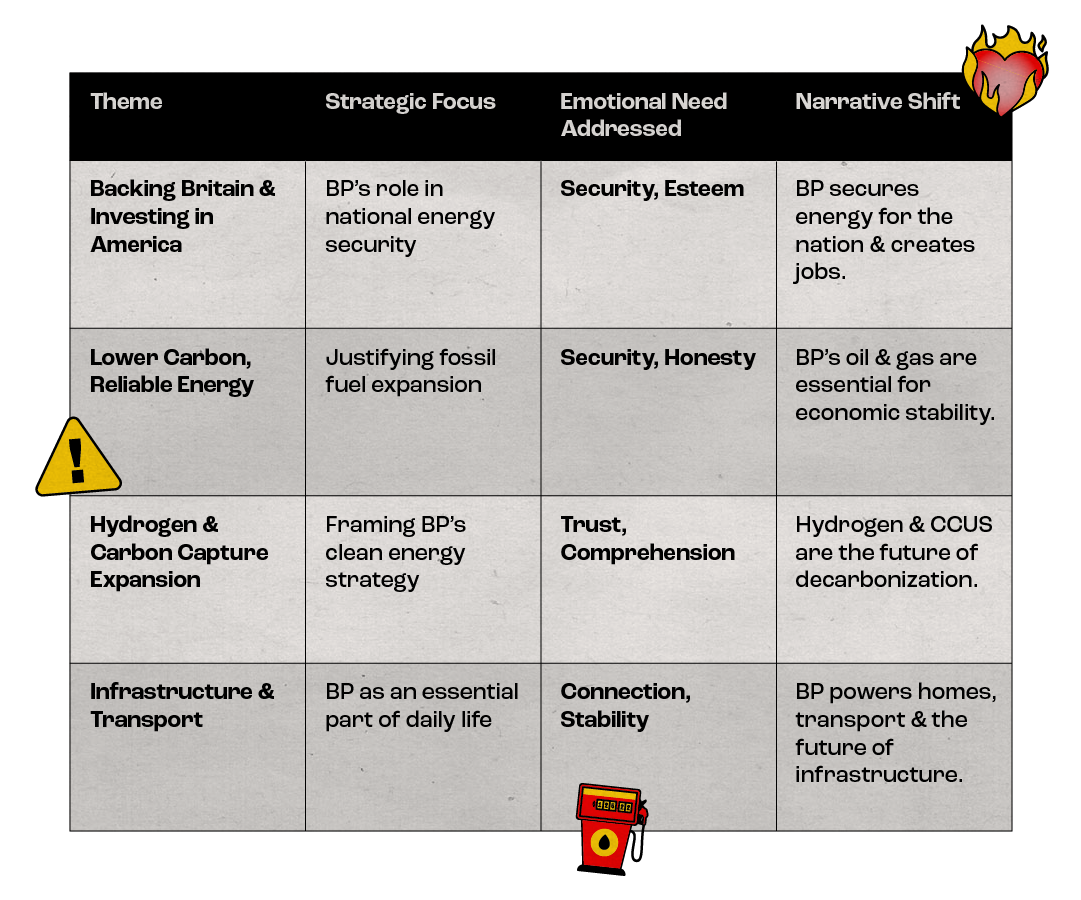
BP has a prominent timeline around the Ukraine invasion. Post-Deepwater, they reset their strategy to focus on net zero, but this left them exposed when their competitors doubled down on fossil fuels after Russia invaded Ukraine. They were too far away to catch up, but followed the market and emphasized energy security with messaging focusing on “homegrown energy” and “backing Britain”
Since their 2020 net zero pledge, BP has scaled back on its climate goals every year. In 2020, they aimed to “cut the carbon intensity of the products we sell by 50% by 2050 or sooner.” Their Backing Britain campaign promised to reduce oil and gas production by 40% in 2020, then this figure reduced to 30% in 2023 and 23% in 2024. BP moved from not talking about oil to framing it as a part of a diverse energy mix.
BP’s CEO, Bernard Looney, coined the term “greening companies” to describe companies that are not green today but have ambitions to become so. This narrative helped lower the bar so that BP could be rewarded simply for having the ambition to go green without actually doing the work.
Between 2021 and 2024, BP consistently discussed investing in hydrocarbons and preventing methane emissions as part of its energy system of the future.
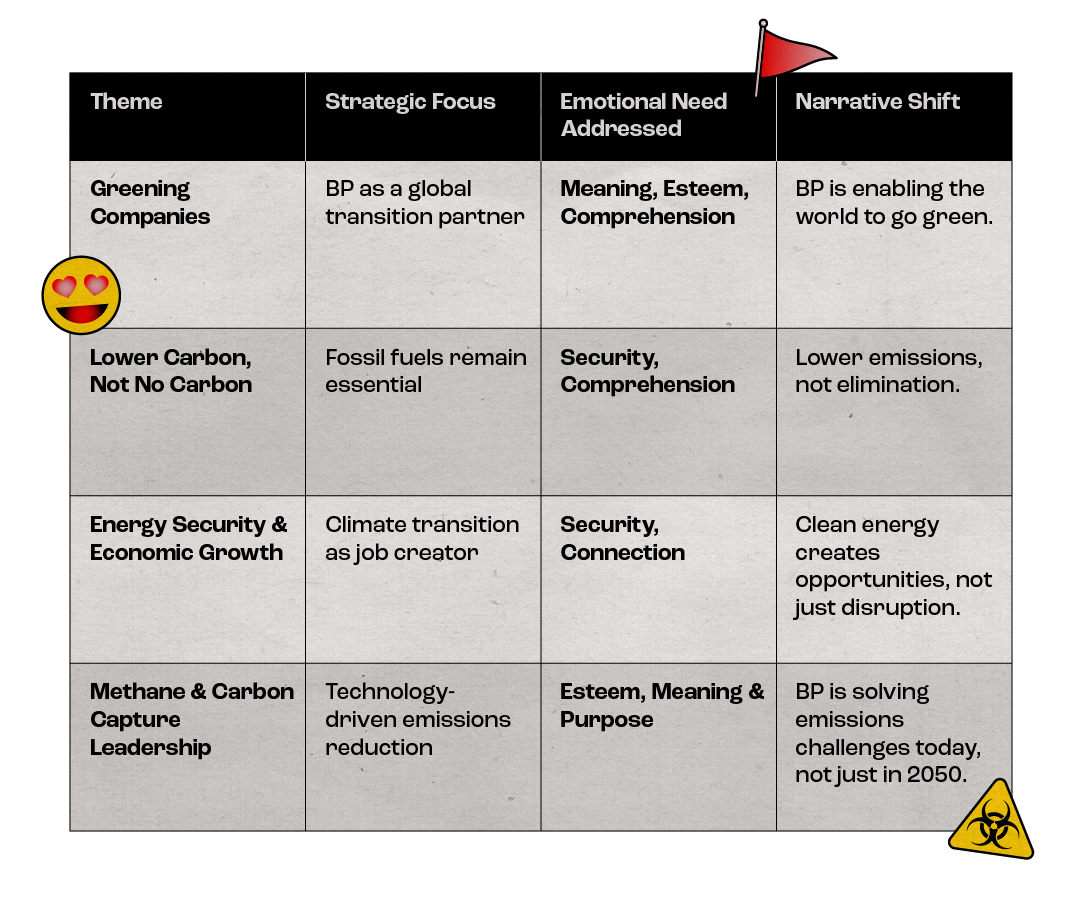
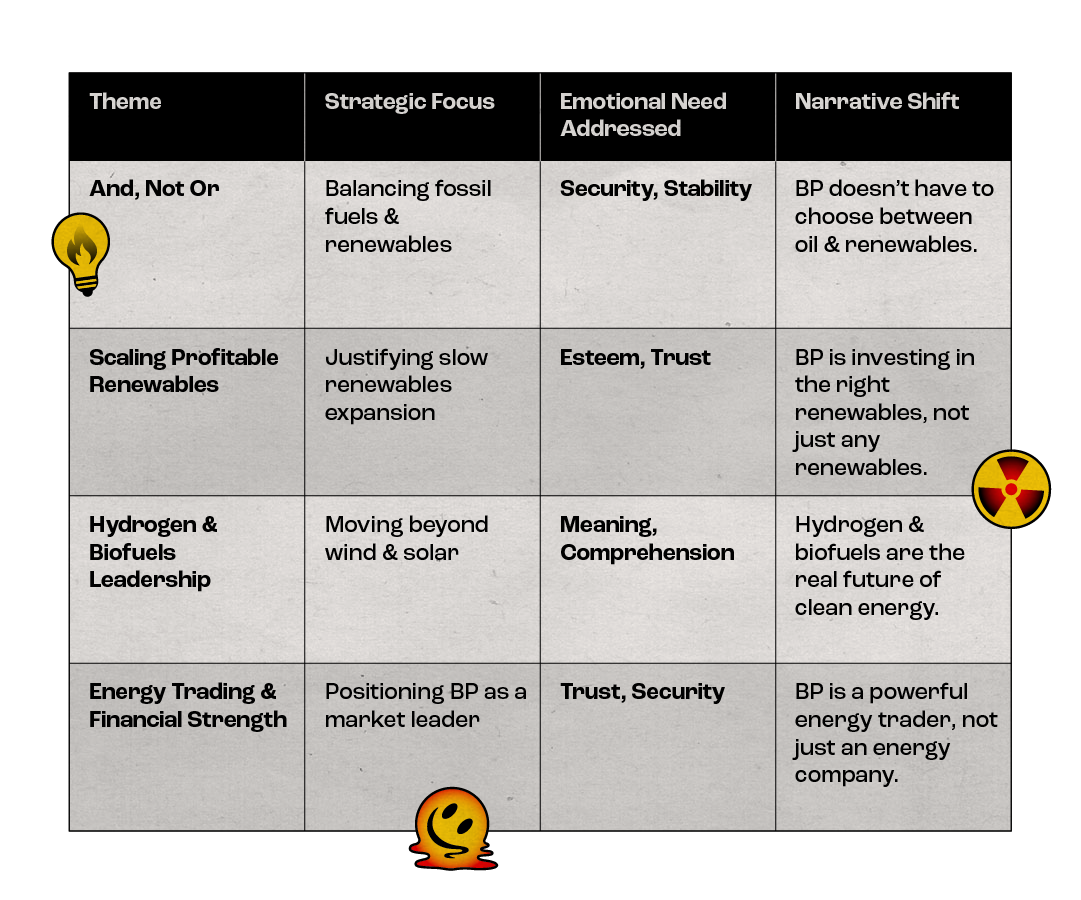
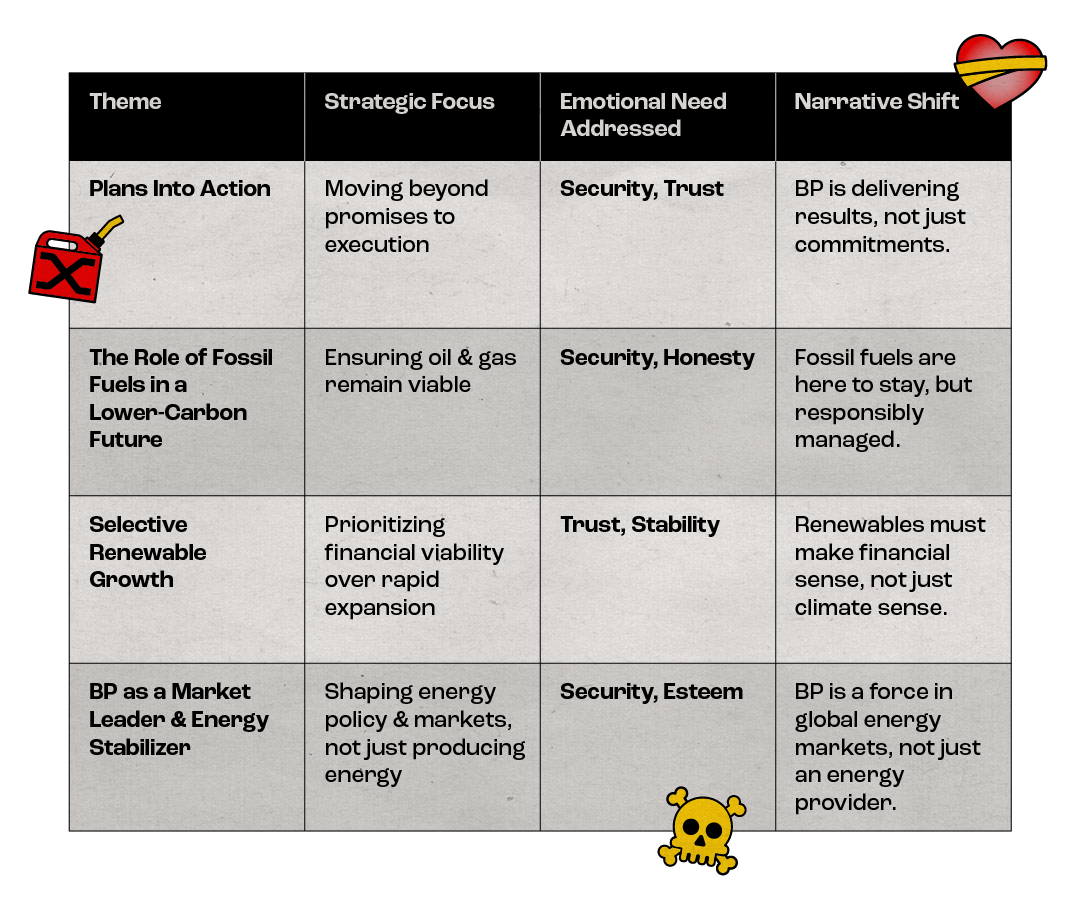
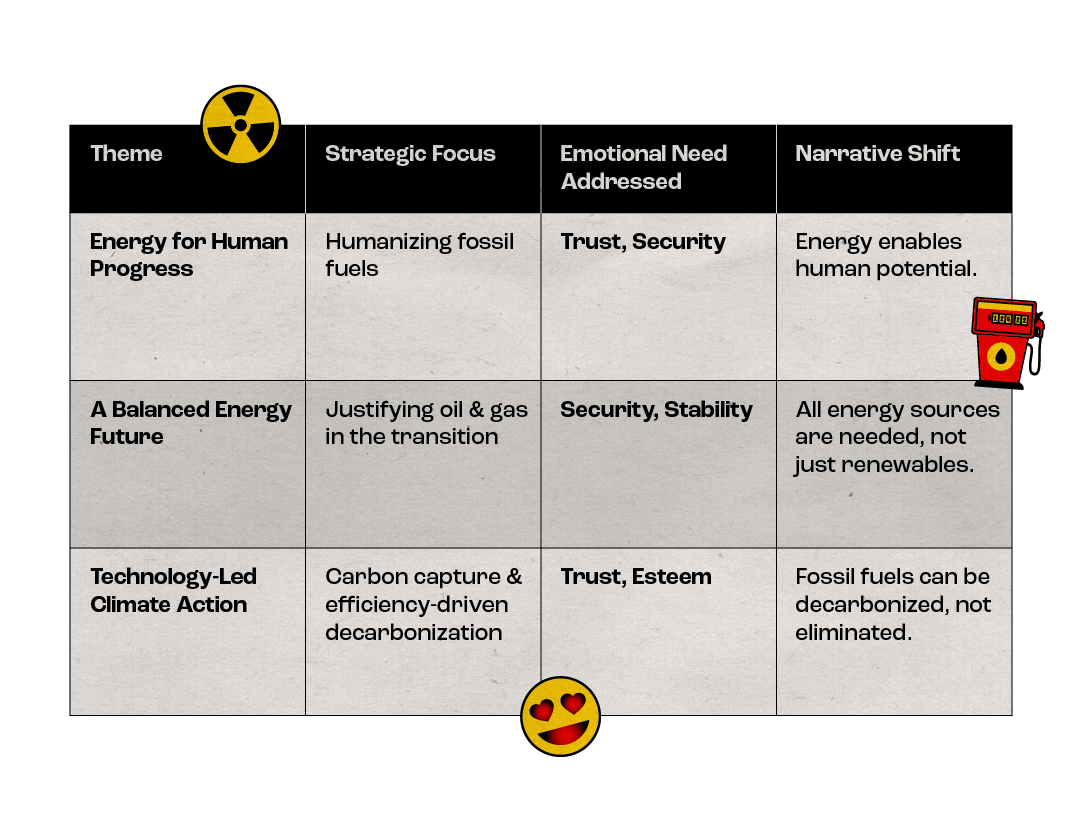
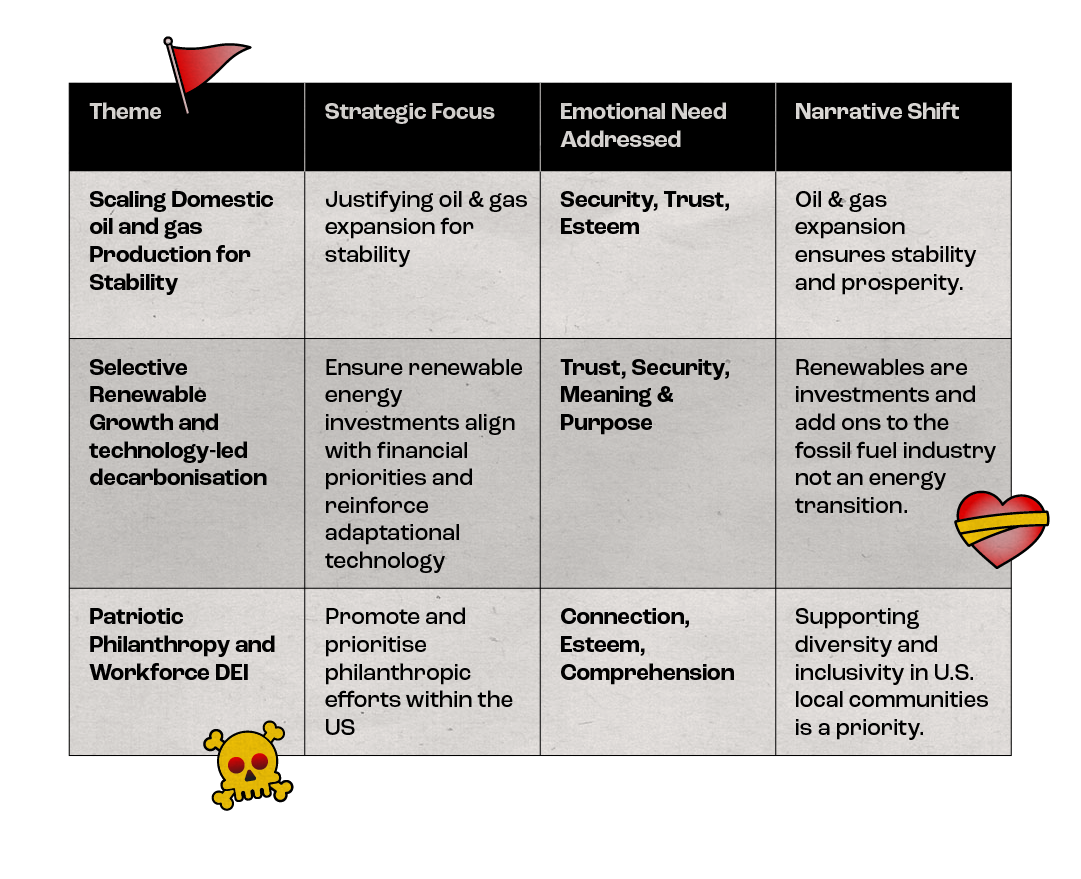
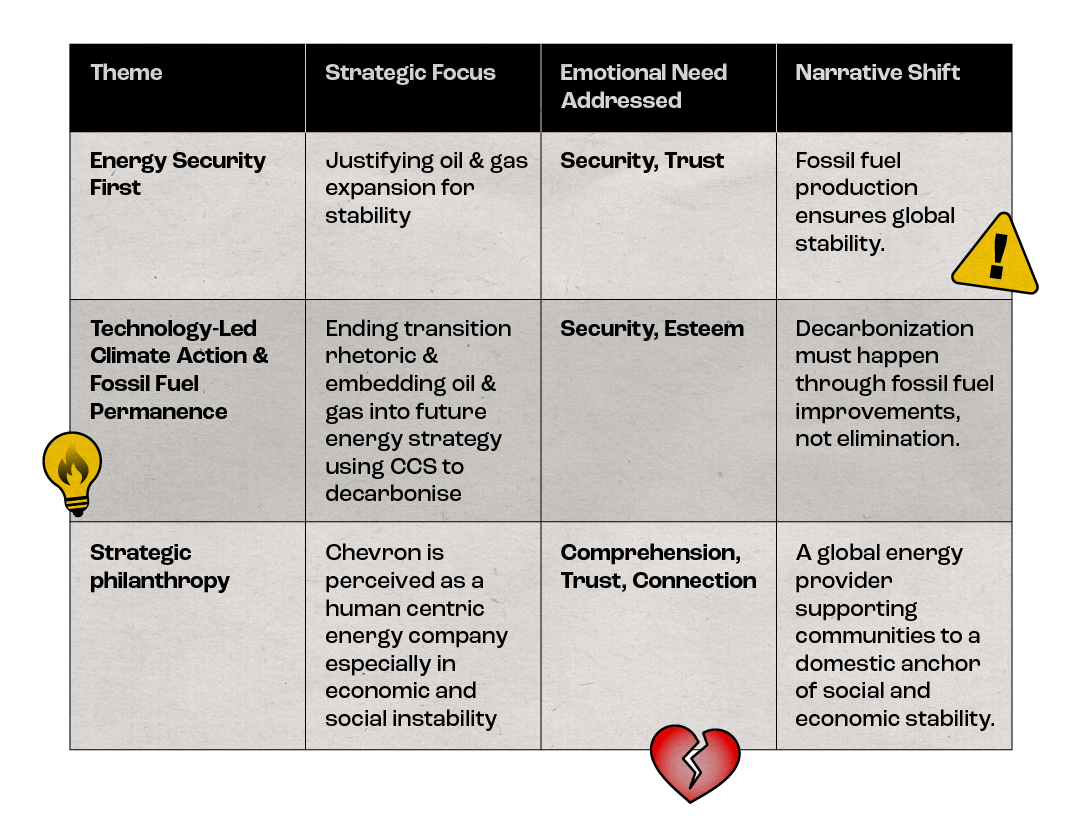
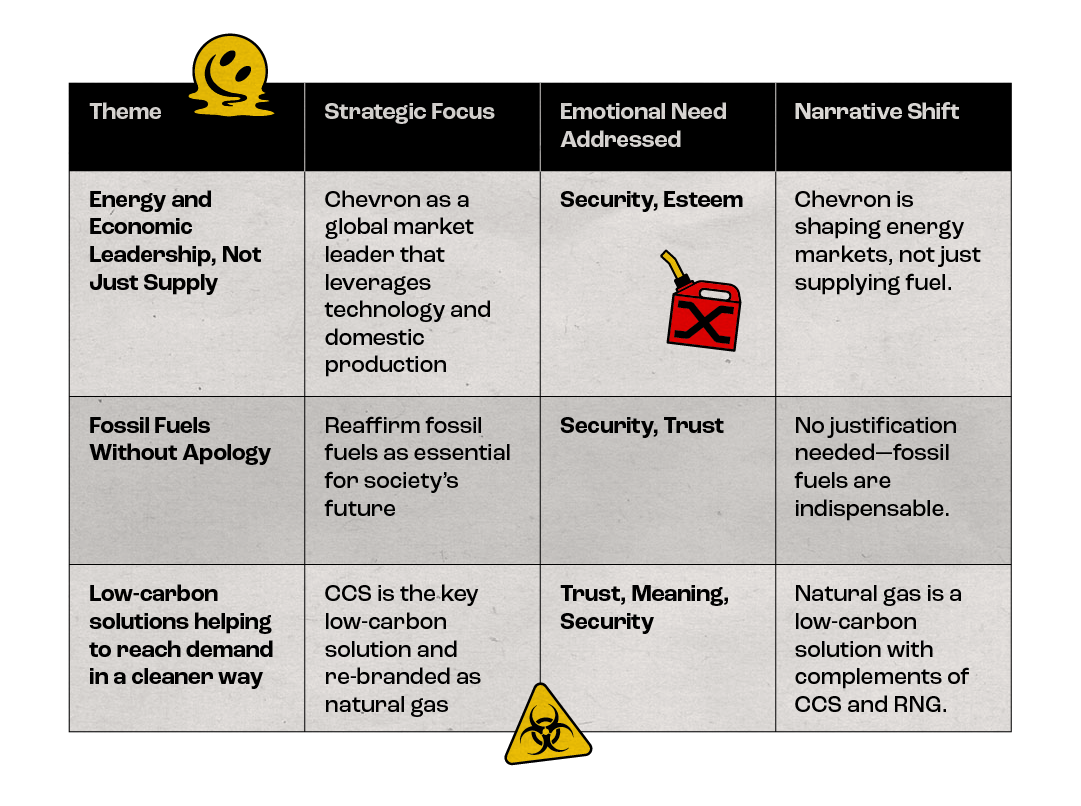
These narrative tables explain how the oil major's advertising changed across four dimensions:
Advertising themes are the topics and messages their campaigns focused on.
Strategic focus describes the underlying business or political objective those campaigns were designed to serve.
Emotional needs addressed refers to a tool in advertising: the psychological desires a campaign is built to activate in its audience.
Narrative shifts are the fundamental claims the oil major is making about itself and its role in the world.
-
In 2021, CEO Bernard Looney gave a speech at BP’s One Young World summit, where he claimed that green companies alone cannot “solve climate change” and that we need “greening companies.” Looney defines greening companies as “companies like BP that are not yet green but have plans to be green.” This narrative became a way for BP to reward their virtue signaling and claim they are better than green companies because they have more resources and a stronger position.
Key campaigns:
Greening Companies (2021, U.S. and U.K., Landor): Landor worked with BP to expand this platform into a campaign. Looney spoke about BP’s goal of “growing low carbon businesses and shrinking our oil and gas business”, while also recognizing that greening companies “need support and backing of investors.”
-
In 2023, BP announced it would scale back its climate targets after receiving record oil profits. They expanded their messaging to focus on investing in both fossil fuels and renewable energy globally, although their campaign scripts announced “today we’re mostly in oil and gas.”
Key campaigns:
And, Not Or (2023 - 2024, U.S. and U.K.): BP’s narrative shifted from its earlier focus on Beyond Petroleum to positioning fossil fuels as critical for future energy security. The “And, Not Or” campaign was very honest about “keeping oil and gas flowing when and where it’s needed” to meet fossil fuel demand while also developing lower carbon alternatives like hydrogen, wind farms and EV chargers.
-
Immediately after the Ukraine invasion, BP launched its Backing Britain campaign emphasizing “homegrown energy”, North Sea oil and gas, and the UK’s “plan to boost long-term energy security and cut emissions.” Although BP admitted “most of our production is oil and gas,” they continued to promote their net-zero-by-2050 goal.
Key campaigns:
Backing Britain (2022 - 2024, UK): Highlight show BP is “keeping oil and gas flowing” while developing UK-based energy solutions like offshore wind, EV charging and hydrogen to “help meet today’s energy needs.”
The Energy Trilemma (2022, T Brand Studio): The New York Times’ T Brand Studio created a podcast for BP, which promoted BP’s focus on “delivering energy that’s secure, affordable and lower carbon” and explored how the world’s largest high-emission industries are decarbonizing.
-
BP took its energy security messaging global with new campaigns called Investing in America and Accelerating Australia. These campaigns used the same themes, focusing on domestic energy supply and how BP is creating jobs and powering the economy. Eventually, in 2025, BP announced that they were dropping its renewables strategy and investing in oil and gas production, giving in to its reputation as “one of the bad guys.”
Key campaigns:
-
BP is an expert in greenwashing, but now, they are content with being a “greening company.” They’ve used strategic language to advertise “lower” instead of low carbon and claim that being a “greening” instead of a green company gives them a business advantage. In 2020, they changed their entire strategy to reflect net zero, then suddenly pivoted towards energy security once oil became profitable. Despite trying to follow the market, they were the slowest company in our analysis to shift to energy security messaging and investors say they have underperformed in the market for over 10 years.
-
Chevron is infamous for its history of human rights abuses and harmful action towards communities of color in the United States, from polluting the Amazon to refinery explosions poisoning local refugee populations. In response, they’ve built a brand identity around being “The Human Energy Company” and investing in philanthropy. However, since 2020, their advertising campaigns have used nationalism and economic stability as themes to convince people that domestic oil and gas investment is essential. Chevron has built a human-focused and innovation-driven strategy to frame climate action as a technological process, not a shift away from oil and gas.
-
Like ExxonMobil, Chevron has set targets saying they “aspire” to reduce the intensity of their Scope 1 and 2 emissions, but have not made any absolute emissions cuts or real promises to stop or reduce oil or gas exploration or production. In 2021, due to a historic majority vote by shareholders supporting climate proposals, despite opposition from the board, Chevron was required to report on whether its lobbying activities aligned with the Paris Agreement. The resulting report was called “greenwashing” by the Union of Concerned Scientists. Since then, investor concern over climate risk subsided in favor of fossil fuel profitability.
-
Chevron’s campaigns platform employees and their stories to humanize the company and present fossil fuel production as an enabler of human achievement
Their marketing focuses on creating a “diverse” and “pragmatic” energy mix, which frames oil and gas as critical to economic stability
They call themselves “responsible” and “human” to build trust
They discuss a “balanced energy future” as a way to normalize continued oil and gas investment under the guise of responsible energy transition
Chevron frames climate action as an innovation challenge. By saying “we are making fossil fuels cleaner,” they convinced shareholders that climate progress can happen through efficiency gains rather than fossil fuel phase-outs
-
In 2020 and 2021, Chevron continued its brand platform as “The Human Energy Company” (developed by mcgarrybowen, now Dentsu, in 2007) and shared employee stories to encourage trust, security and belonging and presented Chevron as a company that cares about people and local economies. Their campaigns also emphasized overseas philanthropy in Thailand, Indonesia and India.
It’s Only Human (2020 - 2022, Wavemaker): This campaign released several ads exploring renewable solutions, from “Pasture” which discusses turning “farm waste into renewable natural gas” to “Progress” where they claim to be “tying our executives' pay to lowering the carbon emissions intensity of our operations.” While they released this campaign, Chevron invested $20 billion in oil and gas exploration.
The Humans Behind the Human Energy Company (2021): Video series featuring a diverse roster of Chevron employees promoting its sustainable credentials, including Joy the geologist who says Chevron is creating a “lower-carbon future” and Tommy the communications manager, who credits Chevron for helping to “repair and restore land for future generations.”
-
In 2023, Chevron doubled down on nationalism, framing domestic fossil fuel production as essential to national security and economic prosperity while using alternatives like CCS, biofuels, renewable diesel and renewable natural gas (RNG) to reinforce climate credibility.
Key campaigns:
Energy in Progress (2023 - at least 2026): Chevron released a new campaign to frame increased fossil fuel production as a “responsible” solution to meet global demand and energy security challenges. The campaign states that “oil and gas are an important part of the energy mix and will continue to be into the future” and that the transition will be slow and take “more than a little time.” The TV ads and YouTube content highlighted carbon capture, renewable diesel, RNG and biofuels as solutions but emphasized their role in supporting, not replacing, fossil fuels.
-
Chevron rapidly adopted energy security messaging after Russia’s invasion of Ukraine and presented increasing fossil fuel production as a solution to stabilize global markets and ensure economic resilience. Patriotism became a part of their core strategy.
Although Chevron continued running TV ads focusing on overseas philanthropy, this messaging disappeared from their social media accounts after the Ukraine invasion and was replaced with domestic community impact stories focused on national identity.
Key campaigns:
It’s Only Human (continued): This campaign was developed to include energy security messaging in the ad “Energy Demands” which framed increased production in the Permian Basin as a way to “offset rising energy demands and lower carbon emissions,” using deceptive language like “offset” to confuse viewers into believing increased production will balance the energy mix.
-
In 2024, Chevron solidified its commitment to fossil fuels, positioning itself as a responsible energy leader by framing innovation and carbon management (rather than transition) as the key to a sustainable future. CEO Mike Wirth gave a speech emphasizing natural gas as the “lower carbon” fuel of the future.
Energy in Progress (2023 - at least 2026): The campaign developed to include educational content to explain how methane detection, renewable diesel and CCS work and share case studies of expansion in Colorado and deep-sea drilling in the Gulf of Mexico. Chevron presents this work as a climate solution and a safe way to create jobs and “support local communities”, but their underwater drilling in the Gulf of Mexico is at higher pressures than Deepwater Horizon and comes with extreme risk and consequence.
-
Chevron has always advocated for fossil fuels, but between 2021 and 2024, it moved from presenting itself as an innovative, people-first energy company to an assertive leader in fossil fuel markets and global energy policy. Its messaging shifted from justifying fossil fuels in a balanced energy mix to insisting that oil and gas are essential for global stability and that carbon capture and natural gas can sustain fossil fuel dependence indefinitely.
-
ExxonMobil is famously the company that led and funded climate change denial from the 1980s to the 2000s, despite their own research, which confirmed, as early as the 1970s, the scientific consensus of climate change. Today, they are still selling false solutions and misleading the public, primarily through CCS, “green” hydrogen and algae.
-
Like Chevron, ExxonMobil has only made Scope 1 and 2 emissions targets around their operated assets, but no real climate commitments to reduce their Scope 3 emissions, which reflect the end use of their oil and gas products. In 2025, German asset management firm Union Investment sold its stake in ExxonMobil due to Exxon’s “insufficient commitment” to climate targets, especially their lack of Scope 3 targets, which “make up about 90 per cent of total emissions.”
-
Compared to other oil majors, ExxonMobil made the biggest investment in fossil fuels. In 2022, they broke records with $56 billion in profit and a rising stock price due to a focus on oil production
Their marketing usually focuses on an American audience, but in mid 2022, they launched their energy security narrative in European countries
They’re strategic with language — referencing ’lower’ instead of low carbon and ‘greener’ not green energy
Their campaigns use fearmongering when talking about energy security and insist that in order to protect future generations, we can’t divest from fossil fuels.
Unlike other oil majors, their narrative shifts aligned less with Russia’s invasion of Ukraine and more with U.S. geopolitics, such as changes in policies and governance
-
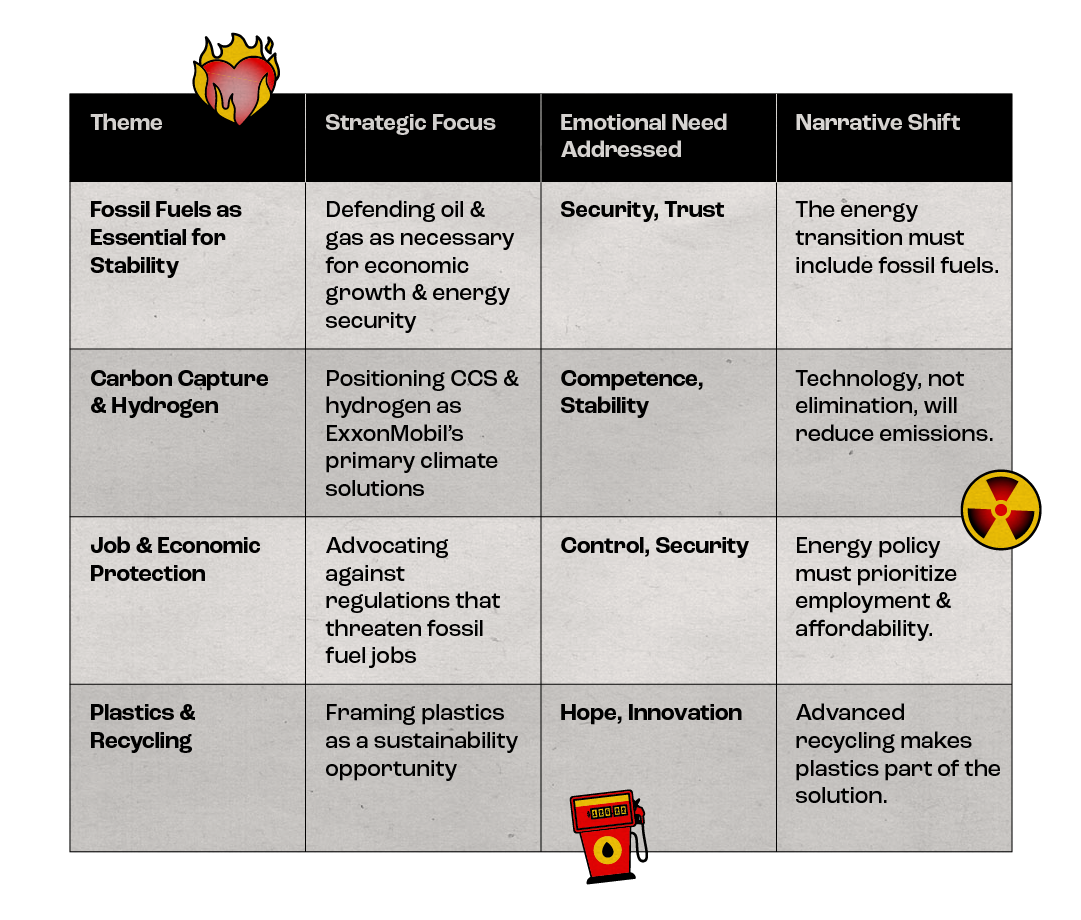
In 2021, ExxonMobil began defensively, positioning fossil fuels as indispensable to climate goals. The narrative focused on CCS, advanced plastics, framing natural gas as a “bridge fuel”, and positioning oil and gas as necessary for economic stability. Their Facebook ads encouraged public action against proposed fossil fuel taxes as a way to protect American jobs and affordable energy.
Key campaigns:
ExxonMobil’s Energy and Carbon 2021 report (p. 21), which developed into their Advancing Climate Solutions campaign (Euro RCSG and UM), said they would work on “reducing greenhouse gas emissions” but that “oil and natural gas remain essential components of the energy mix”
Energy Action Alert: ExxonMobil ran a series of Facebook ads opposing a ban on natural gas, which used alarmist and fearmongering language like “energy action alert” and “protect America’s energy future”
-
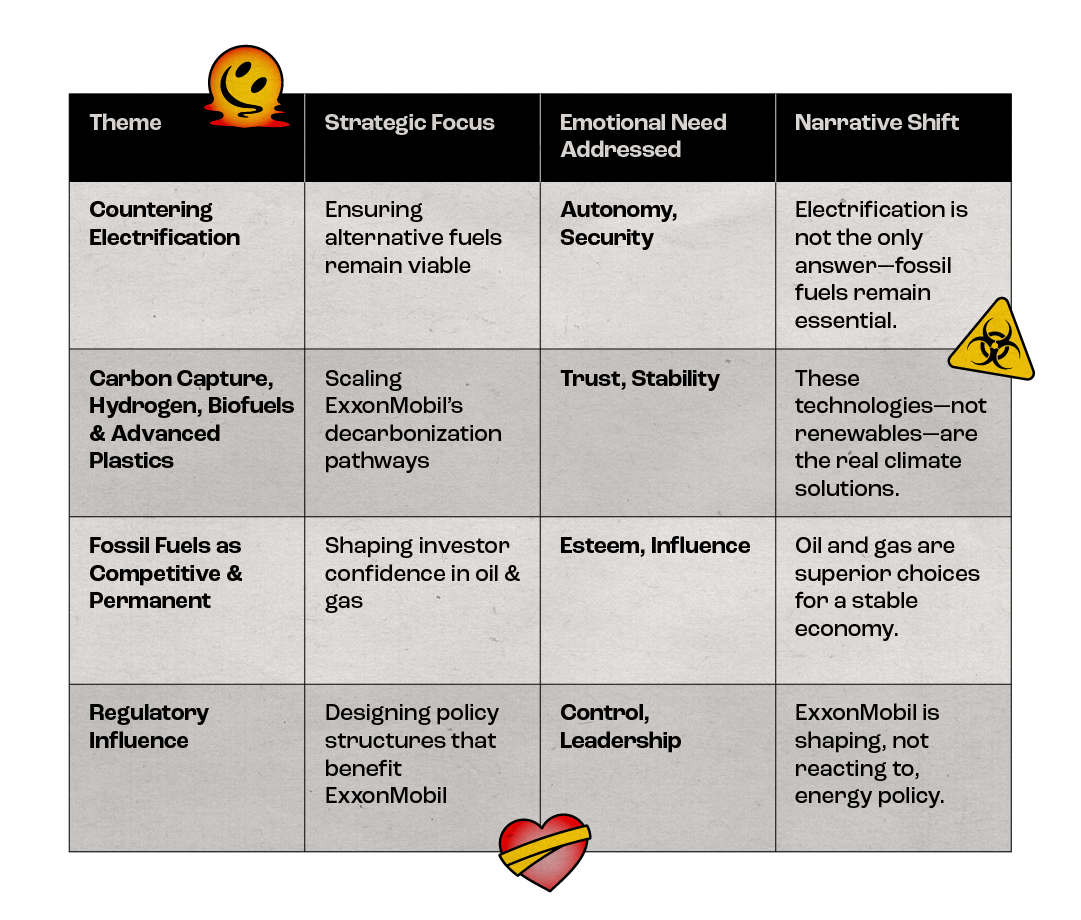
In 2023, ExxonMobil shifted from defending fossil fuels to actively promoting oil and gas as superior energy choices. The 2023 edition of their Advancing Climate Solutions report claimed that “oil and natural gas continue to play an important role” in the global energy mix and “sustained investment is needed to meet demand”. ExxonMobil challenged electrification with their "Breaking Free" campaign and aggressively shaped regulatory discussions to favor its low-carbon solutions over renewable expansion.
Breaking Free (2023, U.S., Europe and Asia campaign by Martin Williams (Omnicom) and Stink Films): In response to the popularity of EVs, ExxonMobil released an anti-EV campaign which viewers called “expertly crafted propaganda”, picturing people struggling to go to work, get a coffee and go on dates with meters of thick digital cables weighing them down. In order to ‘break free’, they cut the cables and go on a drive, portraying fossil fuels as enabling “unplugged” freedom. This campaign was taken down quickly due to backlash
-
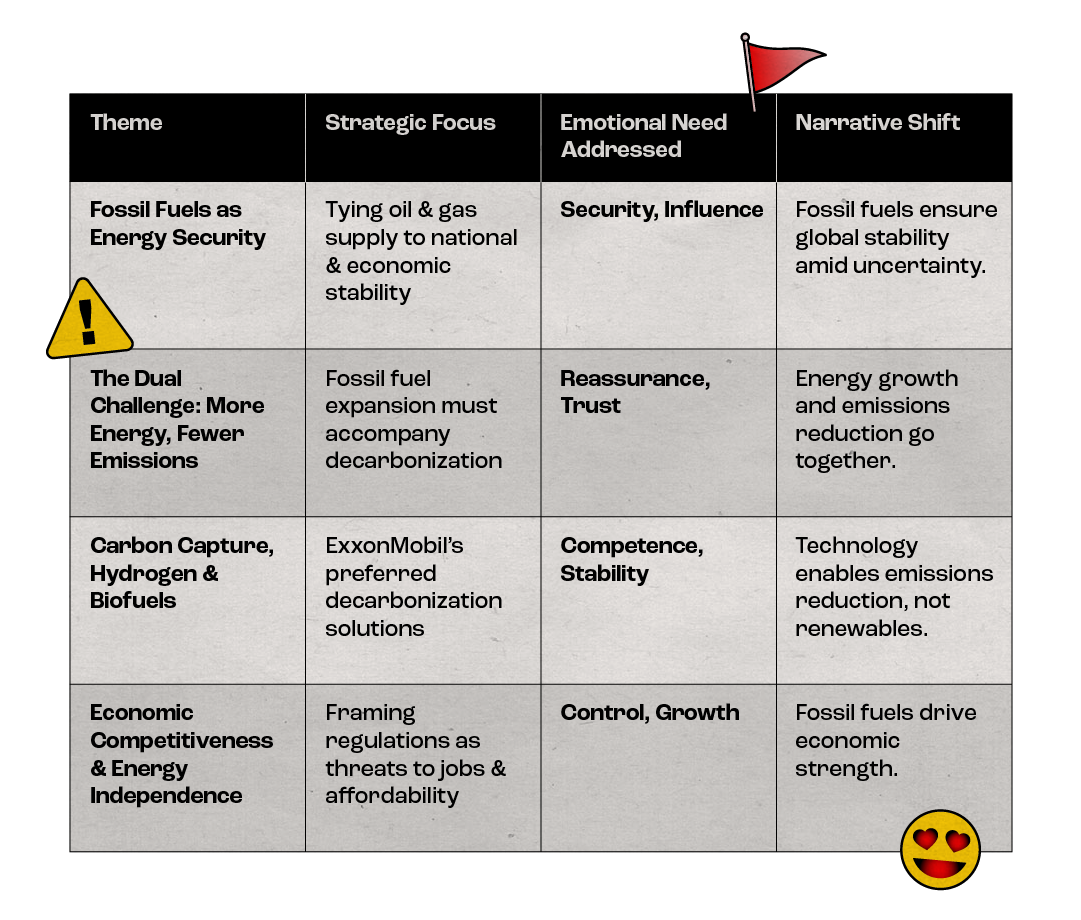
By 2022, ExxonMobil adopted a "dual challenge" narrative to meet energy demand with fewer emissions. This allowed them to position fossil fuels as essential and also promote decarbonization technologies like carbon capture, hydrogen and biofuels. They continued encouraging policy lobbying against energy taxes to protect American jobs and affordable energy.
Advancing Climate Solutions report: Shifted its language from discussing “clean energy” to “lower-emission solutions”. Embedded energy security as a core justification for fossil fuel expansion.
Policy Lobbying (U.S.): Continuing from 2021, ExxonMobil encouraged public action against proposed fossil fuel taxes. Their ads urged the reader to sign pledges or contact their local representatives to oppose tax hikes, otherwise they would not have affordable and reliable energy, jobs would be lost, and there would be economic despair.
-
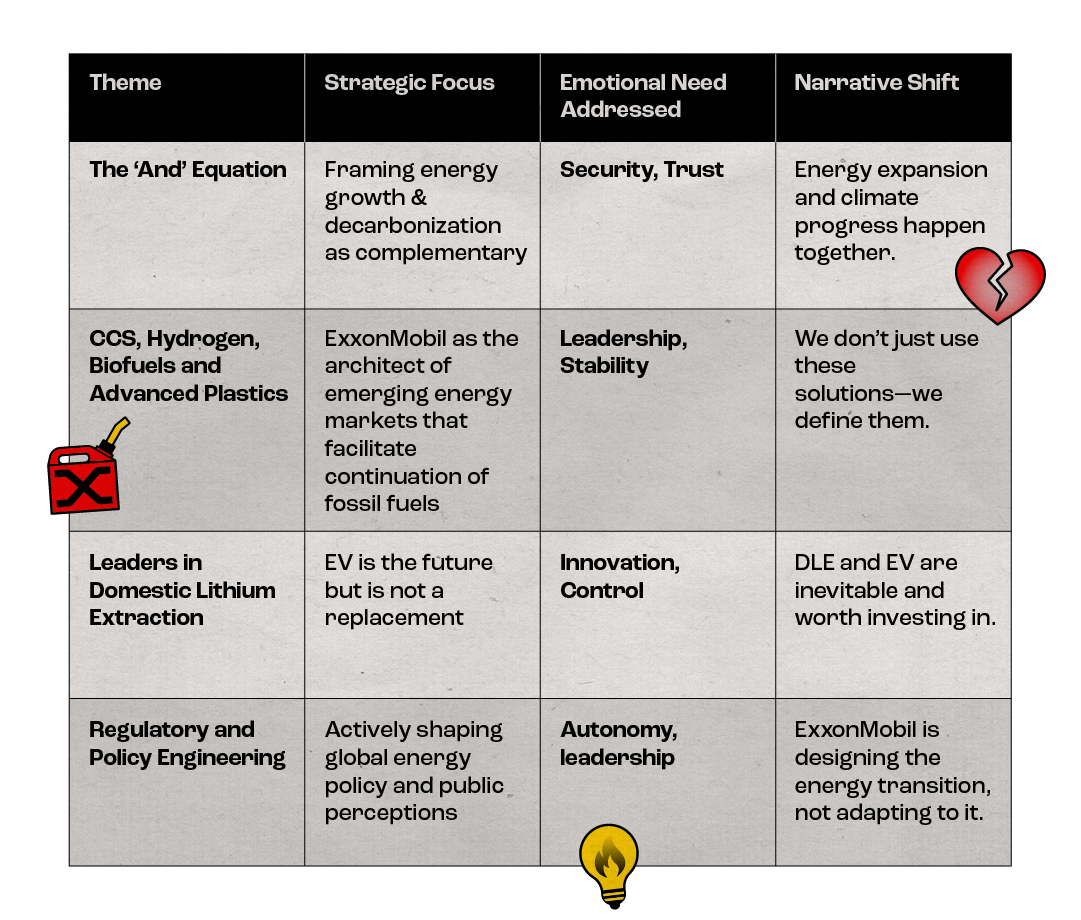
By 2024, ExxonMobil’s narrative pivoted from being anti-EV to embracing electrification through lithium extraction, while simultaneously maintaining fossil fuels as essential. The messaging became about creating an "and" equation — arguing that fossil fuel expansion and emissions reduction could coexist. ExxonMobil positioned itself not just as a participant in the energy transition, but as its architect.
Let’s Deliver: Global campaign by BBDO, Mirada, UM (IPG Mediabrands) and Washington Post Creative Group): It promoted carbon capture and “clean energy from hydrogen” as a scalable solution to deliver “lower emissions for heavy industries”, even though CCS has not delivered at scale.
DLE (Direct Lithium Extraction): In contrast to ExxonMobil’s previous anti-EV campaign, this new campaign promoted electrification through lithium extraction as “environmentally responsible” to make sure oil and gas are still perceived as essential for a diverse energy mix.
-
Between 2020 and 2024, the core strategy remained consistent: ensure fossil fuels remained central to global energy markets while presenting ExxonMobil as an innovative leader in climate solutions. The company shifted from defensive justification to proactive market design, moving from explaining its investments to dictating the terms of the global energy transition.
-
Shell has known about the climate crisis since 1991, but has invested millions into increasing oil and gas production and lobbying against climate action. Between 2020 and 2024, Shell moved from positioning itself as a net zero leader to insisting fossil fuels have a long-term role in “creating the energy system of the future.” Their campaigns promoted gas as a climate solution for the clean energy transition to justify continued LNG and natural gas investments. You can see this clearly in their messaging, with their annual Energy Transition Strategy report mentioning LNG 90 times in 2024 as compared to only 8 times in 2021.
-
In 2020, Shell announced its goal to become a net zero carbon company by 2050. From 2018 onwards, there was increased shareholder support of renewable energy, which rose to 30% in 2021 due to a climate proposal by shareholder group FollowThis, but then dropped to single figures once investors favored fossil fuel profitability. In the past few years, Shell has weakened and eventually abandoned their net zero target and decreased their investment in renewables to 8% of their total spend in 2024 and 12% in 2025.
-
Shell’s net zero pledge gave them climate credibility, but their strategy increasingly prioritized fossil fuel expansion, particularly in LNG, whilst cutting back on climate targets and pushing the transition back into the long term
Shell moved from positioning LNG as a “clean” bridge fuel to a future growth market, ensuring that gas remained a key part of energy transition discussions by representing it as a low-carbon alternative to oil and coal
Shell framed decarbonization as a business opportunity and reassured stakeholders that they would maintain financial stability and the profitability of oil and gas by emphasizing selective renewable growth over rapid transition
They positioned carbon offsets and CCS as climate solutions to shift responsibility onto consumers and justify continued fossil fuel investments
Their campaigns focused on energy security and how fossil fuels “keep the lights on” and power the economy, implying that companies which are focusing on clean energy are denying people jobs
-
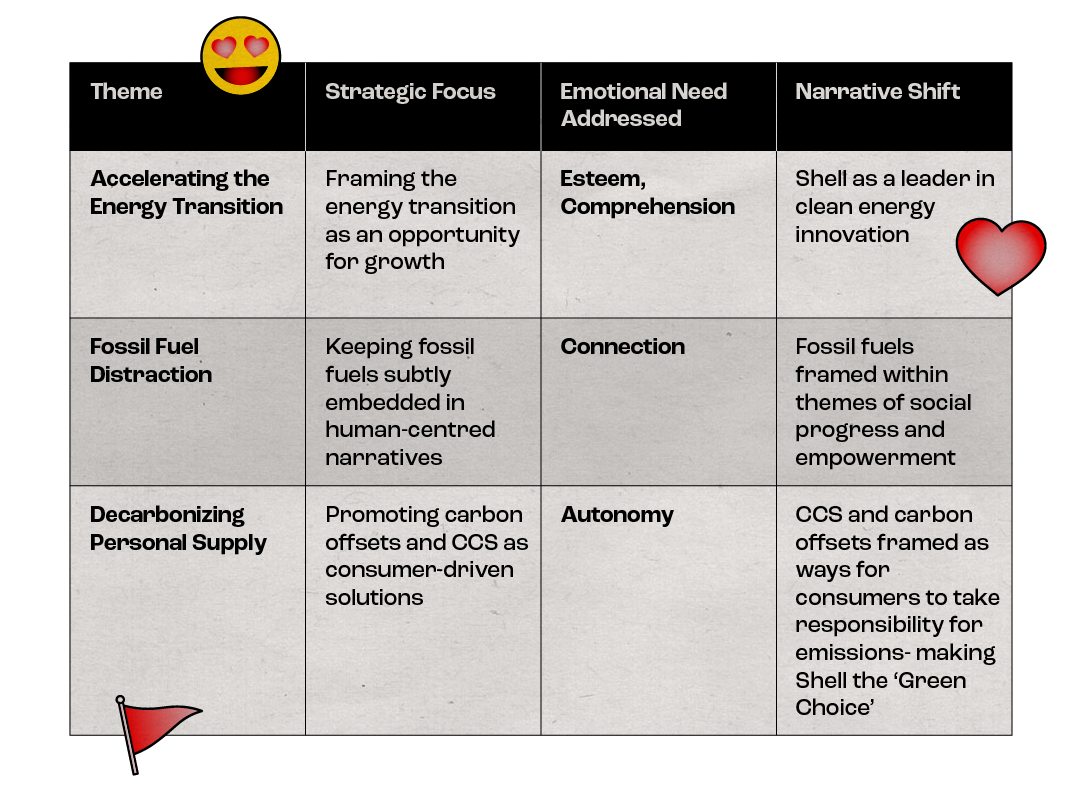
In 2021, Shell positioned itself as a global leader in the energy transition, presenting climate action as both a necessity and an opportunity for business growth. They launched their Powering Progress strategy to move towards net zero emissions without fundamentally disrupting their core fossil fuel business. Their key narrative theme was accelerating to net zero, with fossil fuels subtly embedded in narratives of progress, mobility and inclusivity.
Key campaigns:
Accelerate Together: In the "Accelerating to Net Zero emissions” video, Shell discussed how their “target is to become a net zero emissions energy business by 2050 or sooner” but established that “natural gas will continue to play an important role supporting the transition from coal and compensating for the intermittency of renewables.”
Make The Future (2016 - 2021): Shell attached this net zero messaging to its ongoing Make The Future campaign, with Facebook ads sharing that they are “transforming our business plans to meet our target as society progresses towards a lower carbon world.”
-
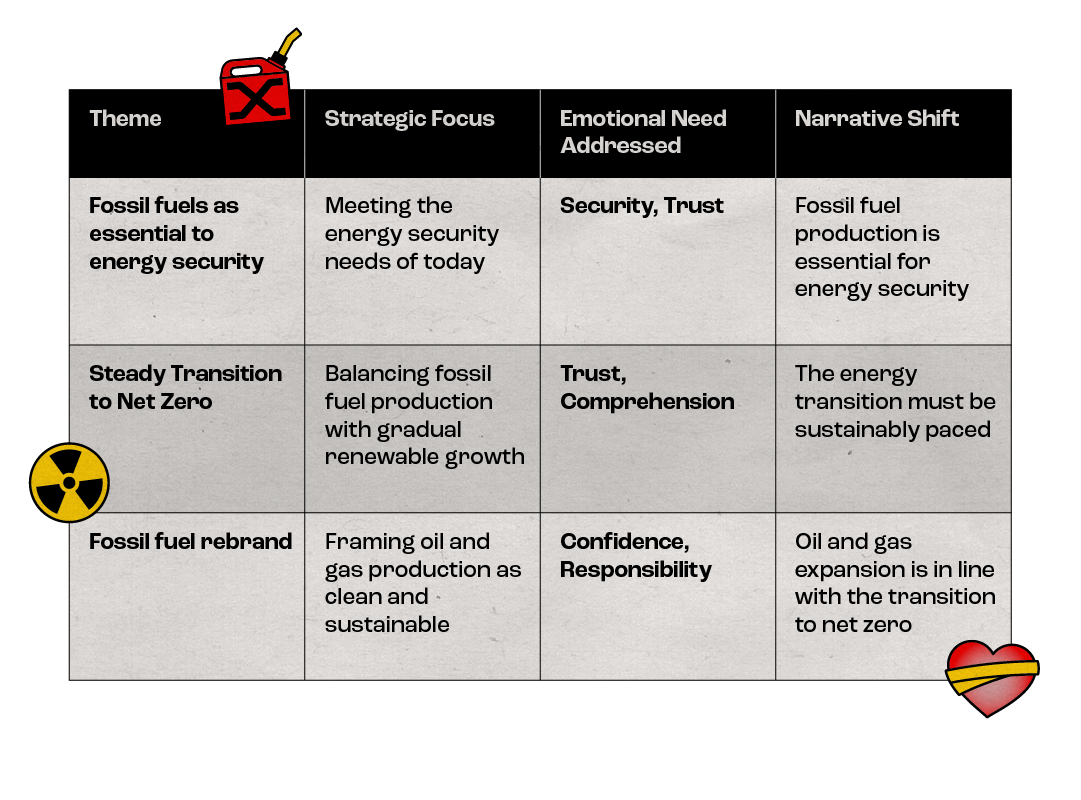
Shell became more confident with promoting fossil fuel expansion and adopted a “both, and” narrative to present fossil fuels as vital for energy security while transitioning to net zero. Wael Sawan took over as CEO, and Shell prioritized financial performance over renewables expansion. Since their net zero pledge gave them climate credibility, Shell’s campaigns presented carbon offsets and CCS as industry-scale solutions to justify continued fossil fuel dominance.
Key campaigns:
Moving Forward With Everybody (2023): This offshoot of the Powering Progress campaign interviews Shell employees who discuss how “oil and gas developments feed our community [and how Shell] creates jobs [and] empowers people’s lives.” One ad claims “oil produced in the Gulf of Mexico has some of the lowest greenhouse gas intensity in the world” to justify Shell’s Vito deepwater project and another credits Shell with helping New Orleans rebuild after Hurricane Katrina.
-
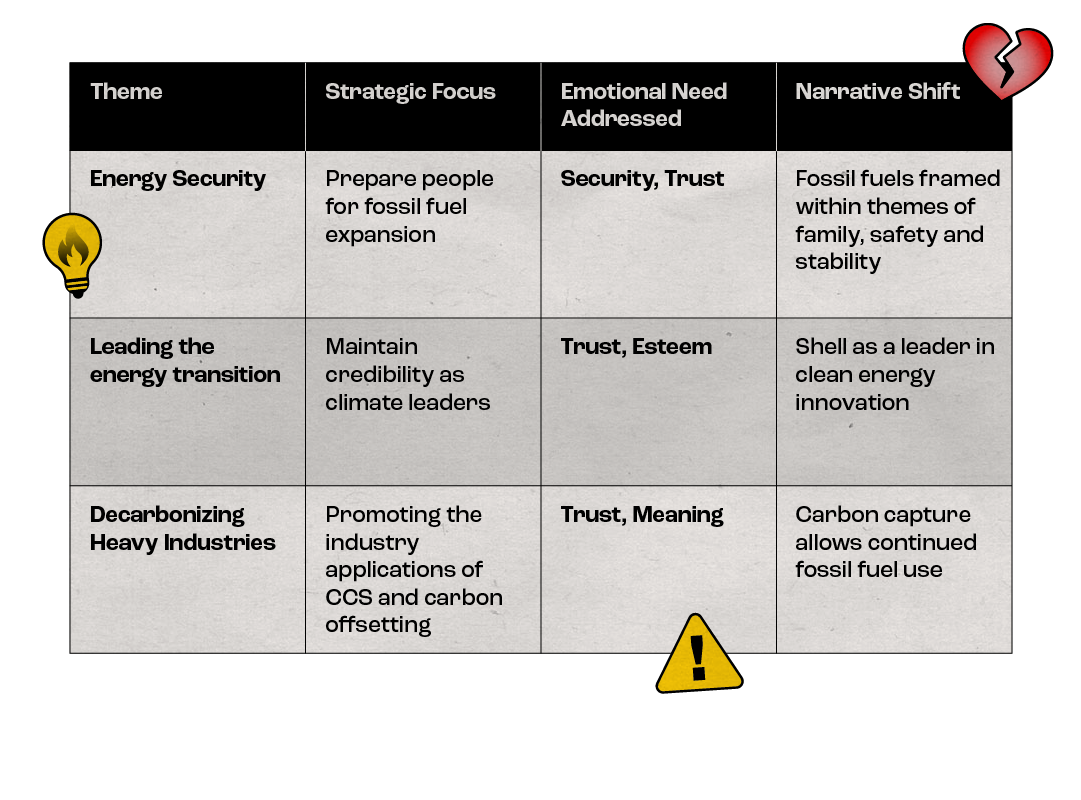
In response to the global energy crisis, Shell’s strategy pivoted to prepare the public for fossil fuel expansion while maintaining its image as a climate leader. Its slogan became ”delivering the energy the world needs today, whilst building the energy system of the future.” Shell framed fossil fuels within themes of family, freedom and safety and emphasized the importance of energy security while promoting electric vehicles and solar. The strategy was localized for different geographies, with UK & Europe ads engaging with greenwashing, U.S. ads highlighting progress and economic growth, and Australian campaigns being more lighthearted with a focus on family.
Key campaigns:
Ready for Cleaner Energy (2022 - 2023, UK, Wunderman Thompson / VML): This campaign positioned Shell as the driving force behind the UK’s energy transition through offering “low-carbon choices” like EV charging points. However, in response to a greenwashing complaint by AdFree Cities, three ads from this campaign were banned in the UK by the Advertising Standards Authority for misleading claims saying that Shell offers “100% renewable electricity”, is “working on a wind project that will power over 6 billion homes” and “aims to fit 50,000 [EV chargers] nationwide by 2025,” when their business was over 95% reliant on fossil fuels.
Powering Progress (2022 - 2025, Global, Wunderman Thompson / VML): in response to the company’s new strategy, the first Powering Progress ads focused on innovation in wind, solar and CCS created by Shell. In our analysis, most of Shell’s Meta ads around this campaign have been removed from the platform for violating guidelines, with some which were only live for one day before being banned.
-
In 2024, Shell became more focused on delivering profitable energy than talking about transition. Their message was clear: fossil fuels are here to stay. They normalized fossil fuel reliance as an inevitable aspect of everyday life during the ongoing energy transition and positioned LNG as both essential for the transition and a long-term energy solution.
Key campaigns:
Powering Progress (2024, UK, VML and Havas): Shell released a new ad in its Powering Progress campaign that received 76 ASA complaints in the UK for misleading environmental claims, showing EV chargers, an offshore rig and miniature windfarms to represent Shell’s investment in the energy transition despite their continued reliance on fossil fuels. However, the ad was not banned.
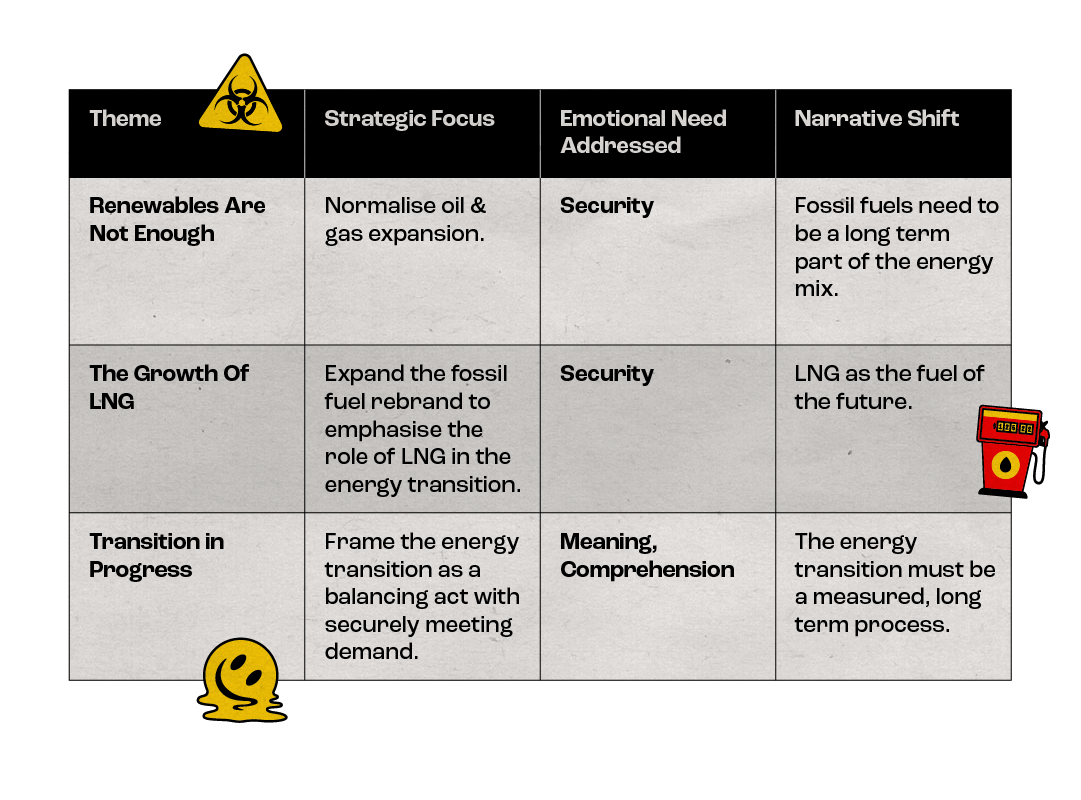
-
Between 2021 and 2024, Shell’s messaging moved from positioning itself as a leader in the energy transition to strategically reinforcing the long-term role of fossil fuels. While net-zero remained a fixture in its public commitments, Shell’s strategy increasingly prioritized fossil fuel expansion and framed LNG as an indispensable climate solution, whilst cutting back on climate targets and pushing the transition back into the long term.
An amendment was made on March 17, 2026 to correct the phrase “2025 marked the first year renewables overtook coal in the global energy mix.” This has been corrected to “overtook coal in the global electricity mix.”
Thank You & Next Steps
Toxic Accounts reveals a significant shift in fossil fuel advertising, from climate leadership to fossil fuel dominance. We invite you to share this research with your teams and clients using our deck and timeline video.
If you have any questions or data requests, please contact nayantara@fossilfree.media.
F-List 2025
To learn which agencies are still working with fossil fuels, read our F-List report.
To discover which energy companies still use a majority of fossil fuels in their energy mix, view our fossil client database.
Clean Creatives agencies
Over 1500 agencies have signed the Clean Creatives pledge to say no to working with fossil fuel companies, trade associations, or front groups. You can find them here.